
Table of Contents
- Key Takeaways
- Male fertility check after miscarriage: what the tests actually cover
- How to prepare for your sperm analysis after loss
- Understanding what your results mean
- Steps to optimize sperm health after miscarriage
- My perspective on male fertility checks after miscarriage
- Take the next step with Sapyen
- FAQs
Miscarriage is devastating. And while most post-loss conversations focus on the woman's health, a male fertility check after miscarriage is equally critical to understanding what happened and planning what comes next. Recurrent pregnancy loss affects 2 to 5% of couples, and up to half of those cases remain unexplained even after thorough evaluation. Male factors, particularly sperm DNA damage, are frequently overlooked in that workup. This article walks you through the tests available, how to prepare, how to interpret results, and what you can do to improve sperm health before trying again.
Key Takeaways
| Point | Details |
|---|---|
| Standard semen analysis has limits | It does not assess sperm DNA integrity, which is directly linked to miscarriage risk. |
| DNA fragmentation testing matters | Elevated sperm DNA fragmentation is strongly associated with pregnancy loss and poor ART outcomes. |
| Preparation affects accuracy | A 2 to 7 day abstinence window and correct sample handling are required for reliable results. |
| Recovery takes time | Lifestyle changes take roughly 90 days to reflect in sperm quality due to the maturation cycle. |
| Couple-based testing works best | Male evaluation is most useful when coordinated with your partner's full reproductive workup. |
Male fertility check after miscarriage: what the tests actually cover
When clinicians talk about a formal male fertility evaluation, they are referring to a structured assessment of semen quality and, in many cases, sperm DNA integrity. These are two different things, and understanding the distinction matters.
Standard semen analysis
A semen analysis measures the physical characteristics of sperm. The key parameters include:
- Concentration: The number of sperm per milliliter of semen
- Motility: The percentage of sperm that are moving, and how well they move
- Morphology: The proportion of sperm with normal shape and structure
- Vitality: The percentage of live sperm in the sample
- Volume and pH: Overall semen quality indicators
These parameters are assessed against World Health Organization reference ranges. A result outside those ranges does not automatically mean infertility, but it does flag areas worth investigating further.
Advanced sperm DNA fragmentation testing
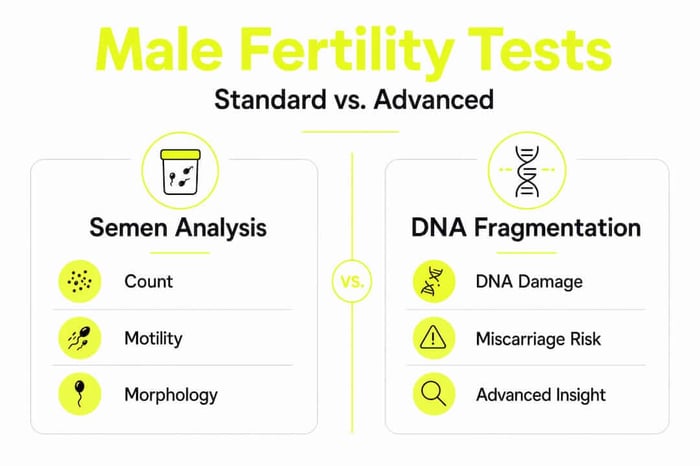 Here is where most standard workups fall short. Standard semen analysis does not assess sperm DNA integrity and can miss DNA damage that plays a direct role in miscarriage risk. A man can have a completely normal semen analysis and still have high levels of sperm DNA fragmentation (SDF), which is the clinical term for breaks or damage within the genetic material of sperm.
Elevated sperm DNA fragmentation significantly increases miscarriage risk and adversely impacts outcomes in assisted reproductive therapies, including ICSI. The main methods used to measure SDF include:
- TUNEL: Detects DNA strand breaks with high sensitivity
- COMET: Measures single and double strand breaks at the individual sperm level
- Sperm Chromatin Dispersion (SCD): Assesses chromatin structure and fragmentation patterns
- SCSA (Sperm Chromatin Structure Assay): Evaluates the susceptibility of sperm DNA to denaturation
Different SDF assays vary in methodology and interpretation thresholds, so your clinician will select the most appropriate test based on your specific situation.
| Test type | What it measures | Miscarriage relevance |
|---|---|---|
| Semen analysis | Concentration, motility, morphology, vitality | Indirect indicator only |
| TUNEL / COMET | DNA strand breaks in individual sperm | Directly linked to pregnancy loss |
| SCD / SCSA | Chromatin integrity and fragmentation rate | High SDF correlates with RPL |
| DNA methylation | Epigenetic markers on sperm DNA | Emerging biomarker for unexplained RPL |
DNA Fragmentation Test

$399.00
$500.00
While this test includes our Core Semen Analysis—measuring count, movement, and shape—our DNA Fragmentation test also reveals the quality of the genetic material inside your sperm, also known as a DNA Fragmentation Index. High fragmentation can impact conception and pregnancy… read more
How to prepare for your sperm analysis after loss
Getting accurate results starts before you ever submit a sample. The preparation steps are straightforward, but skipping them can compromise the reliability of your results.
Observe the correct abstinence window. Studies aligned with WHO guidelines recommend 2 to 7 days of abstinence before sample collection. Too short and sperm counts may be artificially low. Too long and motility can decline.
Collect the sample correctly. Use the collection kit provided by your testing provider. Avoid lubricants unless they are specifically labeled as sperm-safe. Collect the full ejaculate.
Submit the sample within the required window. For clinic-based testing, the sample typically needs to reach the lab within 60 minutes. At-home testing platforms like Sapyen use proprietary stabilization technology that extends this window significantly, removing the time pressure entirely.
Avoid heat exposure in the days before testing. Hot tubs, saunas, and prolonged laptop use on the lap can temporarily affect sperm quality. Give yourself at least 48 to 72 hours clear of these before collection.
Coordinate timing with your partner's evaluation. Male post-miscarriage testing is most valuable when integrated into a comprehensive couple-based workup. Scheduling both assessments together gives your care team a complete picture.
Manage expectations going in. A single test result is a snapshot, not a verdict. Sperm quality fluctuates, and one abnormal result does not define your fertility.
Pro Tip: Adherence to sample collection protocols directly affects the consistency and reliability of your results. Follow the instructions precisely, and if anything goes wrong during collection, contact your provider before submitting.
Understanding what your results mean
Receiving your results is one thing. Knowing what to do with them is another.
Reading a semen analysis
Results are compared against WHO 2021 reference values. If your concentration, motility, or morphology falls below those thresholds, it does not automatically mean you cannot conceive. It does mean there may be a contributing factor worth addressing, especially in the context of pregnancy loss.
Results are categorized using terms like oligospermia (low count), asthenospermia (low motility), and teratospermia (abnormal morphology). These conditions can coexist, which is called oligoasthenoteratospermia, or OAT syndrome.
Reading a DNA fragmentation result
SDF results are typically reported as a percentage. A fragmentation index below 15% is generally considered low risk. Between 15% and 25% is borderline. Above 25% is associated with reduced fertility and higher miscarriage rates. Above 30% significantly increases the likelihood of recurrent pregnancy loss and poor outcomes in IVF cycles.
The key point: advanced sperm assessments uncover hidden DNA damage that conventional analysis simply cannot detect. A normal semen analysis result does not rule out a sperm-related contribution to miscarriage.
When to see a specialist
If your SDF is elevated, or if your semen analysis shows significant abnormalities, a referral to a reproductive urologist or andrologist is the right next step. They can investigate underlying causes such as varicocele, infection, hormonal imbalance, or oxidative stress. Paternal testing is valuable even when a known cause of pregnancy loss has been identified, because treatable male factors can coexist with other issues.
Steps to optimize sperm health after miscarriage
The good news is that sperm quality is not fixed. Because sperm take approximately 90 days to fully mature, the changes you make today will show up in your results roughly three months from now. That timeline is actually useful. It gives you a clear window to act.
Quit smoking. Smoking is one of the most well-documented contributors to sperm DNA damage and oxidative stress. The effect is dose-dependent, meaning less exposure means less damage.
Reduce alcohol intake. Heavy alcohol use is associated with reduced testosterone, lower sperm count, and increased DNA fragmentation. Moderate reduction makes a measurable difference.
Address oxidative stress through diet. Antioxidants including vitamin C, vitamin E, selenium, zinc, and coenzyme Q10 have evidence supporting their role in reducing sperm DNA damage. A diet rich in vegetables, lean protein, and whole grains provides a strong foundation.
Manage heat exposure consistently. Scrotal temperature directly affects sperm production. Avoid prolonged sitting, tight underwear, and heat sources near the groin over the full 90-day maturation window.
Reduce chronic stress. Psychological stress elevates cortisol and can suppress testosterone. After a miscarriage, emotional strain is expected. Seeking support, whether through counseling, peer groups, or your GP, is not just good for your mental health. It is good for your sperm.
Consider targeted supplementation. Antioxidant therapy and, in some cases, prescription interventions like clomiphene or antioxidant combinations may be recommended by a specialist based on your results.
Retest after 90 days. Ovulation can return as soon as two weeks after miscarriage, but sperm quality improvements take the full maturation cycle to appear. Retesting after three months gives you a true picture of whether your changes have worked.
Pro Tip: Male infertility involves multifactorial causes including oxidative stress and DNA damage. Treating it as a lifestyle and medical problem simultaneously, rather than one or the other, produces the best results.
My perspective on male fertility checks after miscarriage
I've seen how often the male side of a miscarriage investigation gets reduced to a single semen analysis, ticked off a checklist, and then set aside. That approach misses the point entirely.
In my experience, the men who get the most useful answers after pregnancy loss are the ones who go beyond the standard test. Sperm DNA fragmentation is genuinely underappreciated in recurrent pregnancy loss pathways. A man with a textbook-normal semen analysis can have an SDF index above 30%. That is not a rare edge case. It is a common finding in couples with unexplained losses.
What I've learned is that the value of testing is not just clinical. It is psychological. When you have data, you have direction. You know what you are working with and what you can change. That is far more useful than sitting in uncertainty wondering whether you played a role.
The couples I've seen navigate this best treat it as a shared investigation. Both partners get tested. Both partners get information. And both partners make changes together. That approach, coordinated and thorough, is what actually moves the needle.
If you have had a miscarriage, a basic sperm count is not enough. Get the full picture. It is available, it is accessible, and it gives you something to act on.

Take the next step with Sapyen
If you are ready to move forward, Sapyen makes it straightforward to get a clinically processed male fertility assessment from home.
Sapyen's DNA fragmentation testing pathways are built specifically for situations like yours. Testing starts at $149 USD for core semen analysis and $399 USD for full DNA fragmentation testing, which includes semen analysis in the price. You collect at home, ship your sample, and receive results processed through accredited laboratories using WHO-aligned methodologies.
If you are not sure which test fits your situation, the Sapyen recommendation quiz takes a few minutes and points you to the right pathway. Coverage through fertility benefits providers including Progyny, Maven, Carrot, and WIN may also apply. Check your insurance and benefits options before you order.
FAQs
What does a male fertility check after miscarriage involve?
It typically includes a standard semen analysis measuring concentration, motility, morphology, and vitality, plus sperm DNA fragmentation testing to assess DNA integrity not captured by conventional analysis.
Can sperm DNA damage cause miscarriage?
Yes. Elevated sperm DNA fragmentation is strongly associated with pregnancy loss and poor outcomes in assisted reproduction. A normal semen analysis does not rule this out.
How long should I wait before testing after a miscarriage?
There is no mandatory waiting period for the man. You can test at any point, though following the standard 2 to 7 day abstinence window before sample collection is required for accurate results.
How long does it take to improve sperm quality?
Sperm take approximately 90 days to mature, so lifestyle changes and medical interventions take about three months to show up in your test results. Retesting after that window gives a true measure of improvement.
Do I need a doctor's referral to get sperm testing?
No. Services like Sapyen allow you to order and complete testing at home without a referral, though sharing results with your doctor or a reproductive specialist is strongly recommended for clinical interpretation.