
Table of Contents
- Why men underutilise fertility testing: the social and psychological barriers
- How knowledge gaps and misconceptions reduce male testing rates
- How healthcare systems and social norms shape male testing behavior
- What practical steps can men take to engage with fertility testing?
- Key takeaways
- The narrative around male fertility testing needs to change
- Take control of your fertility health with Sapyen
- FAQs
Male fertility testing, specifically semen analysis, is the fastest and most direct way to identify whether sperm health is contributing to conception challenges. Yet why men underutilise fertility testing remains one of the most consequential blind spots in reproductive healthcare today. A 2025 study confirms that perceived costs, stigma, and assumptions about fertility status are the most common reasons men delay or avoid evaluation entirely. If you are considering fatherhood, understanding these barriers is the first step toward making an informed decision about your own reproductive health.
Why men underutilise fertility testing: the social and psychological barriers
Social stigma is the single most documented reason men avoid fertility evaluation. In many cultures, male fertility is still conflated with masculinity, sexual performance, and identity. A man who questions his sperm health can feel, consciously or not, that he is questioning his worth. That association is powerful enough to delay action for months or years.
A 2025 study found that stigma and masculinity concerns significantly contribute to delays in male fertility evaluation. This is not a fringe finding. It reflects a pattern seen across clinical settings in the United States, United Kingdom, and Australia, where men are far less likely than their female partners to proactively seek reproductive health assessments.
The emotional weight compounds over time. Men who eventually receive a diagnosis of poor sperm quality often report feelings of anxiety, shame, and isolation. Those emotions are made worse when testing was delayed, because the diagnosis arrives later in the fertility journey when stress is already high and treatment options may be narrower.
Key psychological barriers that drive avoidance include:
- Fear that a poor result confirms a personal failing rather than a medical condition
- Discomfort discussing reproductive health with a physician, particularly a male one
- Assumption that fertility problems are more likely to be the female partner's issue
- Belief that sexual function and fertility are the same thing, which they are not
"Reframing fertility testing as a proactive health behavior, similar to a cholesterol check or blood pressure reading, removes the identity threat. You are not testing your masculinity. You are gathering clinical data." |
Pro Tip: If you are hesitant to bring up fertility testing with your doctor, frame it as a general health check rather than a fertility concern. Most physicians will respond to that framing without judgment, and it gets you the same result.
How knowledge gaps and misconceptions reduce male testing rates
Men's fertility literacy is measurably low. A 2026 analysis published in Scientific Reports found that men answered only 5 of 25 knowledge questions correctly on average, despite many of them actively using fertility supplements. That gap between supplement use and actual knowledge is striking. It suggests men are motivated to act on fertility health but are acting on incomplete or incorrect information.
The most common misconceptions that suppress testing motivation include:
- Fertility equals potency. Men frequently assume that if they can achieve and maintain an erection and ejaculate normally, their sperm must be healthy. Sperm count, motility, and morphology are entirely separate from sexual function and cannot be assessed without laboratory analysis.
- Supplements replace testing. Taking zinc, CoQ10, or other fertility supplements is not a substitute for knowing your baseline. Supplements may support sperm health, but they cannot diagnose low count, poor motility, or DNA fragmentation.
- One test gives a final answer. A 2026 urology review explains that semen analysis is a starting point, not a definitive verdict. Sperm parameters vary significantly from sample to sample, which means one result can mislead in either direction.
- Testing is only for men who have already tried and failed to conceive. Fertility testing is most valuable before you encounter a problem, not after months of unsuccessful attempts.
A 2026 Springer study on diagnostic challenges in semen testing notes that misunderstandings about what semen analysis can and cannot reveal directly suppress men's willingness to test. When men expect a simple pass or fail result and instead receive a complex report with multiple parameters, the experience can feel confusing rather than clarifying.
Pro Tip: Before your test, ask your provider or testing service for a plain-language explanation of what each parameter means. Sapyen includes result interpretation support so you understand what your numbers actually indicate.
How healthcare systems and social norms shape male testing behavior
The clinical pathway for infertility has historically treated it as a female health issue. Women are referred to gynecologists, reproductive endocrinologists, and fertility specialists as a matter of course. Men are often brought in later, if at all, as a secondary consideration. This systemic bias has real consequences for how quickly male factor infertility is identified and addressed.
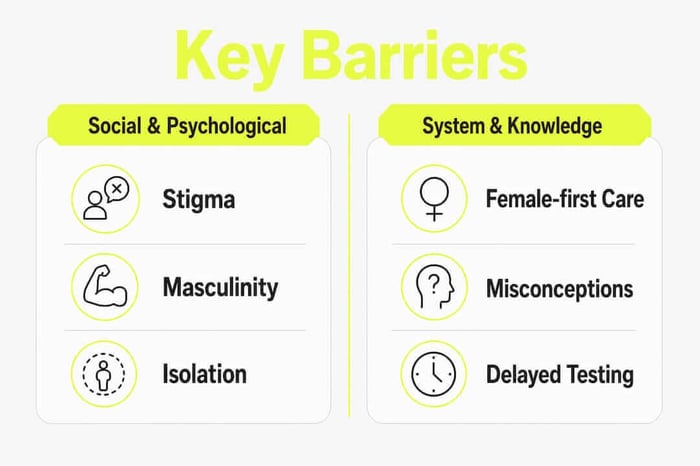
Psychology Today's analysis of male roles in infertility care describes men as frequent "observers" in the fertility journey rather than active patients. Women undergo blood work, ultrasounds, and hormonal assessments while their male partners wait. By the time male evaluation is ordered, months of emotional and financial investment have already been made, and the stakes feel much higher.
The table below illustrates how differently male and female fertility evaluation is typically structured in clinical practice:
| Factor | Female evaluation pathway | Male evaluation pathway |
|---|---|---|
| When testing begins | Often at first consultation | Frequently delayed until female tests are complete |
| Tests ordered | Hormonal panels, ultrasound, AMH | Semen analysis, sometimes hormone levels |
| Specialist referral | Reproductive endocrinologist | Urologist or andrologist, often later |
| Emotional framing | Active patient | Observer or secondary participant |
| Advanced diagnostics | Routinely offered | Often only after repeated failed cycles |
This disparity matters because male factor infertility contributes to roughly half of all cases where couples struggle to conceive. Delaying male evaluation does not protect men from difficult news. It simply delays the point at which useful information becomes available, and increases the emotional burden when it finally arrives.
A 2026 Springer study confirms that early simultaneous evaluation of both partners reduces diagnostic delays and lowers emotional stress across the fertility journey. The data supports what many fertility clinicians already know: testing both partners at the same time is faster, more accurate, and less distressing than the sequential approach most couples still experience.
What practical steps can men take to engage with fertility testing?
Getting started does not require a referral, a clinic visit, or a difficult conversation with a specialist. The barriers to male fertility testing are lower than most men realize, and the information you gain is genuinely useful regardless of your current situation.
Here is a clear starting framework:
- Test early, not reactively. If you are planning to start a family in the next one to three years, a baseline semen analysis now gives you time to act on results without pressure. Waiting until conception has not occurred after six months adds unnecessary stress to the process.
- Plan for more than one test. Because semen parameters vary widely between samples, a single result is a data point, not a diagnosis. Clinicians recommend repeat testing to confirm findings before drawing conclusions or making treatment decisions.
- Test alongside your partner. A 2026 Springer study confirms that joint early evaluation reduces delays and emotional burden for couples. Framing it as a shared health check removes the stigma of individual evaluation.
- Know what semen analysis does and does not measure. Standard analysis covers count, motility, and morphology. It does not assess sperm DNA integrity, which requires a separate DNA fragmentation test. If your standard results are borderline or unexplained fertility challenges persist, DNA fragmentation testing is the logical next step.
- Consider lifestyle factors alongside testing. Heat exposure, smoking, alcohol, and high stress all affect sperm parameters. Testing gives you a baseline. Lifestyle changes give you something to improve toward. You need both.
- Use accessible testing options. At-home testing services like Sapyen's advanced semen analysis remove the clinic visit entirely, which eliminates one of the most commonly cited practical barriers.
Core Semen Analysis

$149.00
$250.00
Get a clear, clinical picture of your sperm health with Sapyen’s Core Semen Analysis. We measure key factors like sperm count, concentration, motility, and morphology. Designed for convenience without compromising accuracy, it’s the easiest way to check in on your… read more
Pro Tip: When speaking with your doctor about fertility, ask specifically: "Should we both be tested at the same time?" Many physicians default to female-first evaluation unless a patient explicitly requests joint assessment.
Key takeaways
Men underutilise fertility testing because stigma, knowledge gaps, and female-first clinical pathways combine to make testing feel unnecessary, threatening, or inaccessible, but early evaluation is the most direct way to reduce uncertainty and protect your reproductive options.
| Point | Details |
|---|---|
| Stigma drives avoidance | Cultural links between fertility and masculinity cause men to delay testing, often for years. |
| Fertility literacy is low | Men answer only 5 of 25 fertility knowledge questions correctly on average, despite supplement use. |
| Systems favor women first | Male evaluation is routinely delayed until after female testing, increasing emotional and diagnostic costs. |
| One test is not enough | Semen parameters vary between samples; repeat testing is required for accurate conclusions. |
| Early joint testing works best | Simultaneous evaluation of both partners reduces delays and lowers stress across the fertility journey. |
The narrative around male fertility testing needs to change
I have spent years looking at how men engage with reproductive health, and the pattern is consistent. Men are not indifferent to fertility. They are operating inside a system that was not built with them in mind, and absorbing cultural messages that make testing feel like an admission of weakness rather than an act of responsibility.
The isolation men describe when they finally receive a difficult fertility result is not inevitable. It is the product of delayed evaluation, poor expectation-setting, and a clinical culture that still treats male infertility as a footnote to female infertility. That needs to change, and it is changing, but slowly.
What I find genuinely encouraging is that the tools now exist to remove most of the practical barriers. At-home testing, sperm cryopreservation for men who want to preserve options, and advanced diagnostics that go beyond standard semen analysis are all accessible in ways they were not five years ago. The remaining barrier is largely psychological, and that is a barrier education can address.
If you are considering fatherhood, the most empowering thing you can do right now is get a baseline. Not because something is wrong, but because knowing your numbers puts you in control of the conversation, the timeline, and the decisions ahead.
Take control of your fertility health with Sapyen
Sapyen's DNA Fragmentation Test goes beyond standard semen analysis to assess sperm DNA Fragmentation patterns, giving you a more complete picture of your reproductive health from home. The process is straightforward: collect your sample, ship it using Sapyen's proprietary SPX72 stabilization technology, and receive clinically processed results through accredited laboratory partners aligned with WHO methodologies.
You do not need a clinic visit or a referral to get started. Sapyen's testing is designed for men who want accurate, clinical-grade information without the barriers that have historically kept male fertility evaluation out of reach. If you are unsure which test fits your situation, the Sapyen recommendation quiz takes less than two minutes and points you toward the right starting point.
DNA Fragmentation Test

$399.00
$500.00
While this test includes our Core Semen Analysis—measuring count, movement, and shape—our DNA Fragmentation test also reveals the quality of the genetic material inside your sperm, also known as a DNA Fragmentation Index. High fragmentation can impact conception and pregnancy… read more
FAQs
What is the most common reason men avoid fertility testing?
The most common barriers to semen testing are perceived costs, stigma, and assumptions about fertility status, according to a 2025 study. Many men also assume that normal sexual function means their sperm health is fine, which is not clinically accurate.
How many semen analysis tests does a man need?
A single semen analysis is a baseline, not a final diagnosis. Because semen parameters vary widely between samples, clinicians recommend at least two tests before drawing conclusions or making treatment decisions.
When should a man get a fertility test?
Testing before you actively try to conceive gives you the most time to act on results. A 2026 Springer study confirms that early simultaneous evaluation of both partners reduces diagnostic delays and emotional stress compared to sequential testing.
Does semen analysis test for everything that affects male fertility?
Standard semen analysis measures count, motility, and morphology but does not assess sperm DNA integrity. A DNA fragmentation test is required to evaluate DNA-level damage, which can affect fertilization and embryo development even when standard parameters appear normal.
Can lifestyle changes replace fertility testing?
Lifestyle improvements such as reducing heat exposure, quitting smoking, and managing stress can support sperm health, but they cannot substitute for testing. You need a baseline measurement to know whether changes are having an effect and whether further clinical evaluation is needed.